The most expensive role in marketing isn't the one you think
Every marketing team has the same bottleneck. It's not the writer. It's not the designer. It's not the person who schedules the social posts.
It's the strategist.
The person who looks at the data and decides what to do next. Who spots the keyword your competitor just started ranking for. Who notices your best article is losing traffic before the damage shows up in your quarterly review. Who connects the dots between a trending topic in your industry and the brief that should exist by Friday.
That person costs $120,000 to $180,000 a year. And most small marketing teams don't have one.
You have yourself. Doing research, strategy, writing, design, distribution, and analysis. Switching between six tools. Making decisions based on whatever you happened to notice that morning.
Maya changes that.
What Maya actually does
Maya is your Chief Growth Officer. She monitors your marketing data continuously and tells you what to do next.
Not in a vague, "here are some suggestions" way. Maya detects specific opportunities and threats across every signal that matters, then takes action when you say the word.
Here's what that looks like in practice.
She detects what you'd miss
Maya runs insight detectors against your data. Every day. Without you asking.
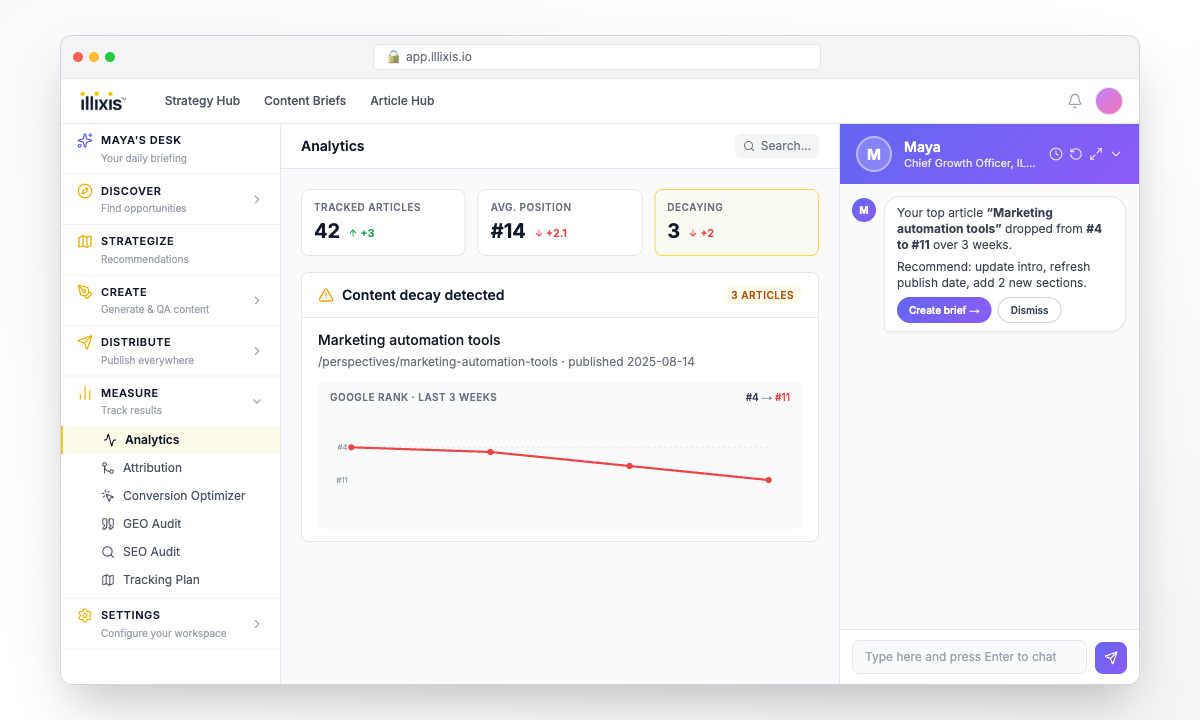
Content decay. Your best-performing article started dropping in rankings three weeks ago. By the time you'd notice in Google Search Console, you'd have lost a month of traffic. Maya flags it on day one with a specific recommendation: update the intro, add a new section on [trending subtopic], refresh the publish date.
Competitive gaps. Your competitor just started ranking for a keyword cluster you're invisible on. Maya identifies the gap, estimates the opportunity, and offers to create a brief for it right now.
Trending topics. A conversation is building in your industry around a topic you haven't covered. Maya spots the trend early, before every other blog has written about it, and suggests you move first.
Quota optimization. You're paying for 30 articles a month but only using 12. Maya notices. She suggests topics for the unused capacity based on what's actually working in your analytics.
She also watches your email performance, social engagement, platform balance, orphan pages, repurpose opportunities, seasonal campaigns, and lead magnet potential. Every signal, running daily, surfaced as prioritized recommendations on your dashboard.
She knows your business
Maya isn't a general-purpose chatbot. She's loaded with domain expertise across seven marketing disciplines: strategy, copywriting, SEO, advertising, analytics, email, and social.
But here's the part that matters: she adapts to the page you're on. When you're looking at your content briefs, Maya speaks as an SEO specialist. When you're building an email sequence, she's an email expert. When you're reviewing ad performance, she's an advertising strategist.
It's how a real Chief Growth Officer works. The same person gives you SEO advice in one meeting and email strategy in the next. Maya does the same thing, grounded in deep domain expertise and your actual business data.
She remembers everything
Every conversation you have with Maya builds on the last one. She remembers what you approved, what you dismissed, what worked, and what didn't.
Ask her about a campaign you discussed two weeks ago. She knows. Ask her to follow up on the brief she suggested last Monday. She'll pick up where you left off.
By month three, Maya knows your brand, your audience, your competitive landscape, and your content preferences better than any freelancer you'd hire. And she never needs a three-month ramp-up period.
What she can do from a single conversation
Maya doesn't just recommend. She executes.
From the chat widget in the corner of your screen, Maya can:
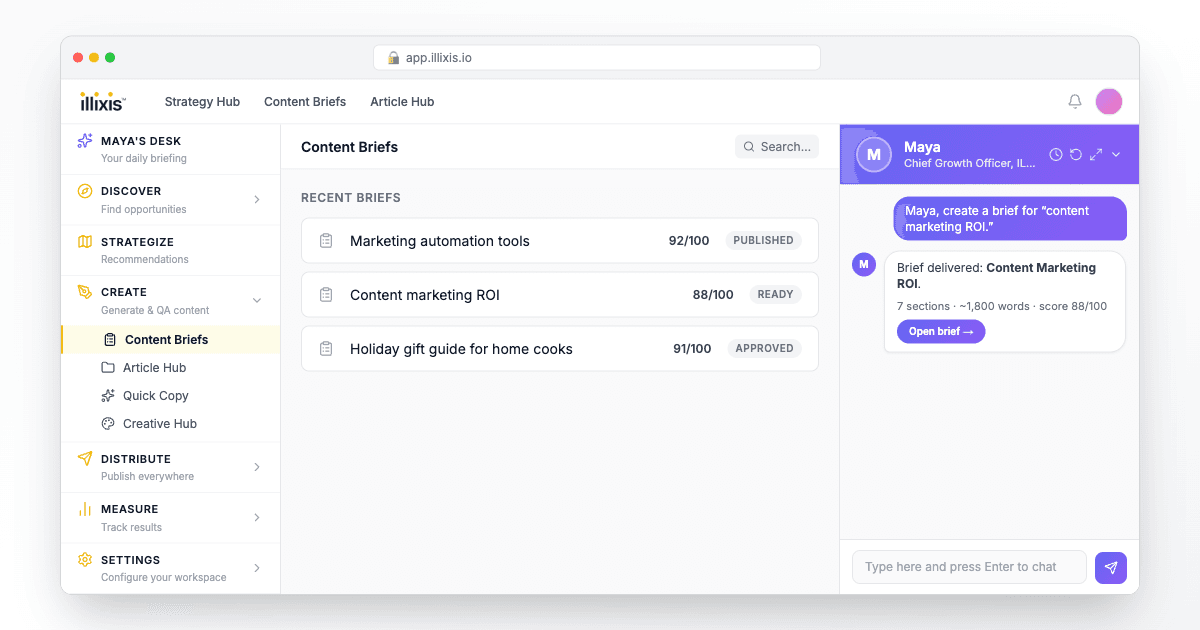
Create a research brief. "Maya, create a brief for 'content marketing ROI.'" She analyzes the top SERP results, identifies gaps in existing content, recommends structure and word count, and delivers a brief you can approve or edit. Three minutes.
Generate a full email sequence. "Build a 5-email welcome sequence for new subscribers." Maya creates the sequence with subject lines, body copy, send timing, and A/B test variants. She draws from a library of preset sequence types or builds custom flows from scratch.
Build a landing page. "Create a landing page for our upcoming webinar." Maya generates the page with headline variations, benefit sections, social proof blocks, and a registration form. Ready for your review.
Write ad copy across platforms. "I need Google and LinkedIn ads for this article." Maya produces headlines, descriptions, and audience targeting recommendations for each platform, formatted to their specific requirements.
Produce a video script. "Turn this article into a 60-second video for Instagram." Maya generates a scene-by-scene storyboard with voiceover script, visual direction, and music suggestions.
Publish content to your website. "Publish the article we approved yesterday." Maya pushes it to your connected CMS.
Improve existing content. "This article scored a B-. Can you fix the issues?" Maya identifies quality problems across 300+ patterns, applies fixes, and resubmits for grading.
Dozens of actions. From a text conversation.

The compound advantage
General-purpose chatbots like ChatGPT, Claude, or Gemini are brilliant for one-off tasks. Ask one to write a paragraph, brainstorm ideas, summarize a document. They're great at that.
But they don't know your brand voice. You re-explain it every session. They don't track your rankings. They can't see your Google Search Console data. They don't detect content decay. They have no idea what your competitors published last week. And they can't publish to your CMS, send emails, create videos, or run ad campaigns.
Maya is connected to your data. She sees your search performance, social metrics, email engagement, ad spend, and content analytics. She acts on what she finds.
The difference isn't intelligence. General-purpose chatbots are remarkably capable. The difference is context and continuity. Maya builds a compound understanding of your business that grows with every conversation, every approval, and every campaign result.
A new freelancer takes three months to learn your brand. Maya starts learning on day one.
She meets you where you are
Maya doesn't wait for you to come to her.
When an article is ready for your review, Maya texts you. When a brief needs approval, she sends a message. You reply with a number: 1 to view, 2 to approve, 3 to dismiss. No need to open the app.
She's available via SMS and WhatsApp. You choose your preferred channel. She respects quiet hours. And when you want to continue a mobile conversation on your desktop, the full history is waiting for you.
Every Monday, Maya sends a weekly digest: the top opportunities she detected, the actions she recommends, and a summary of what happened last week. You start your week knowing exactly where to focus.

Talk to her right now
See the chat widget in the corner of this page? That's Maya. The same strategist, the same knowledge base, the same conversation style you'd get inside the platform.
Ask her a question about your marketing. Paste your website URL and she'll analyze it: your content gaps, your competitive positioning, where you're leaving opportunities on the table. No signup required. No sales call. Just a conversation.
This is what try before you buy looks like when your product is a strategist.
The role that never existed before
Small marketing teams have always had a gap at the top. The strategist role. The person who looks at all the data, connects the dots, and decides what to do next.
You couldn't afford that person. So you did it yourself, between writing articles and scheduling social posts and checking analytics and responding to emails.
Maya fills that gap. She's the Chief Growth Officer who never sleeps. Who monitors your data around the clock. Who remembers every conversation. Who can execute dozens of actions from a single chat.
The gap is closed. The role exists. You're free to do the work only you can do.