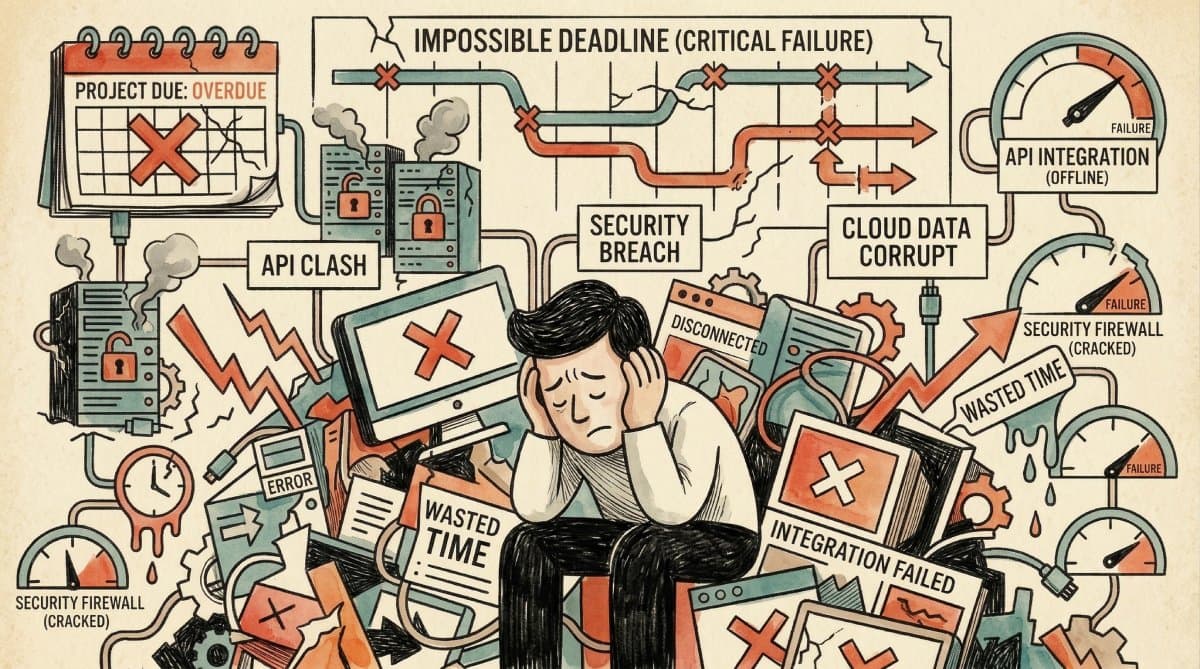
You've played the game. Everyone has.
A message starts at one end of the line. By the time it reaches the other end, it's something else entirely. "Purple elephant riding a bicycle" becomes "people helping writing a tricycle." The whole point of the game is that the message always breaks down. That's what makes it funny.
It's less funny when the message is your brand.
Here's how it works in marketing. You write a brief. It describes your product, your audience, your positioning. You hand it to a writer. The writer interprets the brief and produces an article. Good article. Solid work.
Then the designer gets the article. They don't read the brief. They read the article. They interpret the writer's interpretation and create visuals. The visuals are beautiful. They also emphasize something the writer mentioned in passing and the brief never intended.
Now the social media manager gets the article and the visuals. They don't read the brief either. They skim the article, crop the visuals, and write fifteen posts optimized for engagement on five platforms. Each post is a further compression of an already-compressed interpretation.
The email marketer takes a different angle. The ad copywriter takes another. The video producer reads the article once, pulls three quotes, and scripts something that sounds authoritative but carries almost none of the original strategic intent.
Six specialists. Six interpretations. Six channels. One brand that sounds like six different companies.
Each piece is competent. Some of it is genuinely excellent. None of it is coherent.
This is the game of telephone.
Most people try to fix this with coordination. More meetings. Brand guidelines. Style guides. Slack channels for every project. Weekly creative syncs where everyone gets "aligned." Content calendars that map what goes where and when.
All of this is infrastructure to manage the distortion. Not eliminate it. Manage it.
You're building better telephone lines. Clearer connections. More checkpoints along the way. But the fundamental problem remains: every handoff introduces a new interpretation. Every new interpreter brings their own lens. The message drifts.
The more specialists you add, the more handoffs you create. The more handoffs you create, the more the message drifts. The more the message drifts, the more coordination you need. It's a cycle that scales in exactly the wrong direction.
Picture the following.
In 1503, Francesco del Giocondo commissioned Leonardo da Vinci to paint a portrait of his wife. One artist. One vision. The result was the Mona Lisa. The most recognized painting in human history.
Now imagine he'd commissioned eight artists instead. Lichtenstein paints the upper left. Basquiat takes the upper right. Banksy gets the middle. Warhol does the bottom. Picasso, Pollock, Britto, da Vinci himself. Each working independently. Each a master. None seeing the others' work.
You'd get eight masterful fragments. And one incoherent painting.

That's not a failure of talent. It's a failure of architecture. Eight brilliant artists can't paint one coherent portrait when each is working from their own interpretation of the same face.
This is how most marketing programs work. Blog, email, social, video, ads, landing pages. Each created by a specialist. Each excellent in isolation. Together, a composite that no customer can recognize as one voice.
There's a different way to think about this.
What if instead of writing six things from scratch (one for each channel) you wrote one thing well and grew everything else from it?
Not repurposed. Not reformatted. Not "take the blog post and chop it into tweets." That's just faster telephone. The message still degrades with every compression.
What if it was something closer to how nature works? A cutting from a healthy plant doesn't produce a smaller, worse version of the original. It grows into a full plant. Same DNA. Same species. But genuinely its own organism, adapted to wherever you plant it.

What if marketing worked the same way?
One article. Deeply researched. Strategically structured. Written in one voice. Quality scored, originality verified, facts checked.
From it, an email sequence grows. Not excerpts from the article pasted into a template. A real email sequence that carries the same strategic DNA but speaks the language of the inbox. Different structure. Different cadence. Same core insight.
Social posts grow from the same root. Not pull quotes with a link. Posts that reimagine the article's arguments for people who scroll, not read. Native to the platform. Genuinely new. But unmistakably the same voice.
Video grows from it. Not the article read aloud over stock footage. A script that reinterprets the argument visually. Same thesis. Different medium.
Ad copy. Landing pages. Audio. Each one native to its channel. Each one genuinely new. None of them a degraded copy of the original. All of them carrying the same DNA.
That's not repurposing. That's propagation.
The article is the campaign.
The distinction matters more than it sounds.
Repurposing takes what exists and shrinks it into new containers. You're packaging the same content for different screens.
Propagation grows something new from a shared root. The email doesn't excerpt the article. It extends it. The social post doesn't summarize. It reimagines. Every piece stands on its own. But trace them back and you find the same source.
The result is something that feels impossible with conventional marketing: true consistency without repetition. Every channel sounds like the same company, tells the same story, reinforces the same positioning. But nothing feels recycled.
The reason this hasn't been obvious is that it's always seemed impractical.
The strategist who held the whole picture in their head couldn't follow it all the way through. A strategist can see the entire board. They can brief every position and write the strategy that points everything in the same direction.
What the strategist can't do is follow that strategy across six tools, eight specialists, and ninety handoffs without it dying somewhere in the middle.
So they hire more specialists. Buy more tools. Add more meetings. And the game of telephone gets bigger, not smaller.
Researcher interprets the market. Strategist interprets the researcher. Writer interprets the strategist. Designer interprets the writer. Social manager interprets the designer. Each handoff, another round of telephone. Not because anyone was bad at their job. Because the source of the work never traveled with the work.
That constraint is dissolving.
Imagine one place where the brief lives. Where the article grows from that brief inside the same system. Where the email sequence, the social posts, the ad copy, and the landing page all grow from that same brief. Where nothing has to be exported, attached, pasted into a different tool, re-explained in a Slack thread, or re-interpreted by someone who never read the original document.
The game of telephone ends when you remove the telephone.
It ends when the source travels with the work instead of getting handed off and lost. When every channel reads from the same root, instead of from a copy of a copy of a copy.
No interpretation drift. No compression loss. No six channels telling six different versions of the same story.
One source. Everywhere.
The game of telephone existed because the brief got lost the moment it left the strategist's hands. The coordination existed because nobody downstream could see what the strategist meant. The brand guidelines and style guides and weekly syncs existed because the brief itself never followed the work.
All of that infrastructure existed to manage a problem that no longer needs to exist.
Your marketing team isn't bad at telephone. Nobody is good at telephone. The game is the problem.
Stop playing.