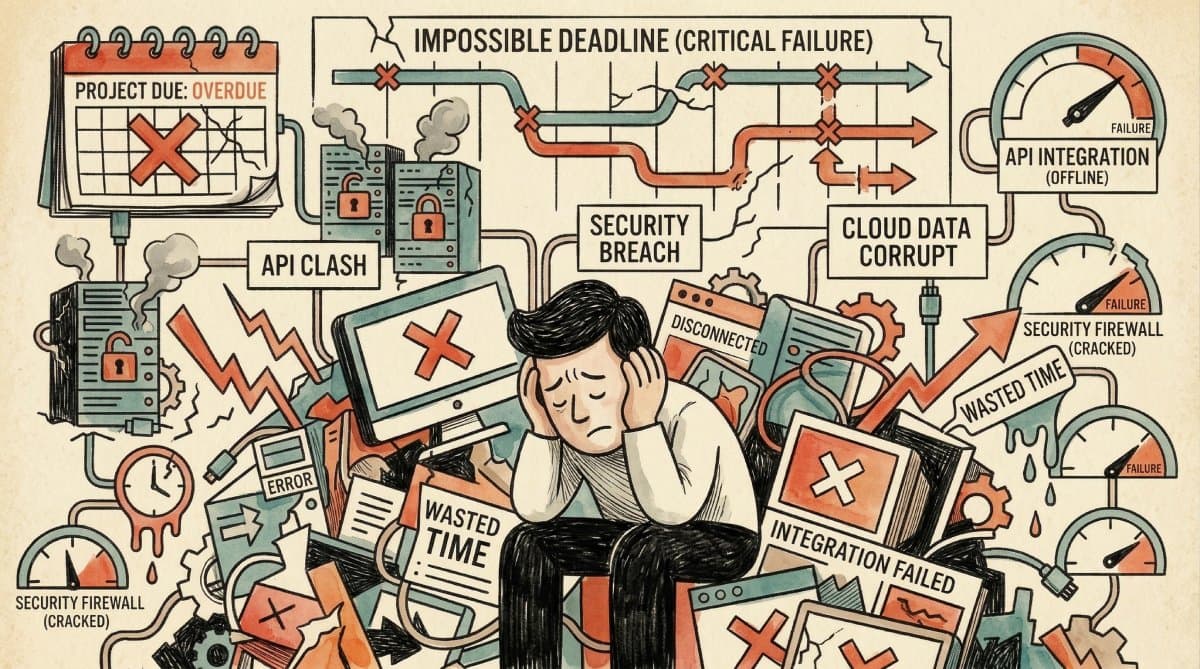
Count your marketing tools. Now count the ones your team actually used this week. That gap between owned and used costs real money every month. But the idle tools aren't the real problem. The real problem is what those tools never did in the first place.
Marketing automation, as the industry defines it, automates tasks: Send this email when someone fills out a form. Post to social on a schedule. Trigger a workflow when a tag gets applied.
That's not marketing. That's plumbing.
Marketing is research, strategy, content creation, creative production, distribution, and analysis. It's figuring out what to say, who to say it to, how to say it, where to put it, and whether it worked. Traditional marketing automation tools handle maybe two of those six stages. The rest falls on your team. Or your agency. Or your weekends.
The 20% Problem
The marketing technology landscape has grown to over 15,000 products across 49 categories. Each one solves a narrow slice of the marketing problem. Email sequencing. Social scheduling. Landing page building. Ad management. Analytics dashboards.
Stack them together and, at best, you've given yourself the illusion of integration. What you actually get is disparate tools with their own logins, their own data silos, their own monthly bills. And your team spending as much time managing the tools as doing the marketing.
But here's the deeper issue. Even if every tool worked perfectly and every integration held, you'd still only be automating the execution layer. The mechanical last mile. Hit send. Publish post. Launch campaign.
The hard part, the 80% that eats your team's hours, happens before any automation triggers:
- Researching your market and competitors
- Building a strategy that connects to business goals
- Writing the emails, the blog posts, the landing pages, the ad copy
- Creating the visuals, the video, the creative assets
- Deciding which channels to prioritize this week
- Analyzing what worked and adjusting the plan
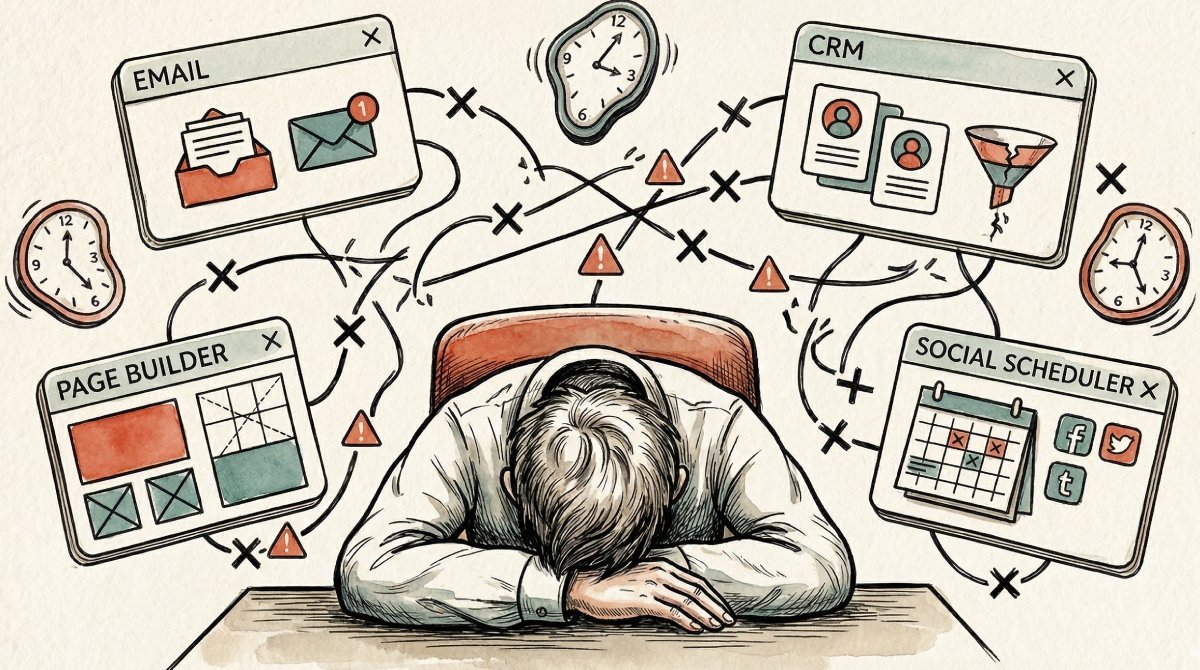
No email automation tool writes the email. No social scheduling tool decides what to post. No landing page builder develops the messaging. And even if they did, each one would produce content in isolation. The email wouldn't know what the landing page says. The social post wouldn't connect to the blog. Every piece would feel like a separate campaign because it was built in a separate tool. Your team would still be responsible for the integration, juggling a patchwork of tools, freelancers, and gut instinct.
“Marketing automation tools automated the easy part and left your team with everything else.”
Why the Industry Sold You Tasks Instead of Marketing
There's a reason automation stopped at task execution. Automating tasks is straightforward engineering. If X happens, do Y. Timing, triggers, templates. Software has handled that for decades.
Automating marketing is a fundamentally harder problem. It requires understanding context, making strategic judgments, creating original content, and adapting to results. Until recently, that required human expertise at every stage. And expertise was scarce.
That scarcity shaped the entire industry. You needed a copywriter for the emails, a designer for the creative, a strategist for the plan, an analyst for the reporting, and a specialist for each tool in the stack. One person couldn't do it all, so vendors sold you tools to manage the handoffs between the people.
That's what most marketing automation actually is: coordination software for specialists.
And vendors had every incentive to keep it that way. More specialization means more tools. More tools mean more subscriptions. According to Gartner, marketing technology accounts for nearly a quarter of marketing budgets, but less than half of those capabilities get used. That's not a failure of adoption. It's the natural result of selling task-level solutions to a program-level problem.
The Feature Trap
Walk into any marketing automation demo. A polished rep clicks through dozens of features in 30 minutes. Dynamic content personalization. Behavioral triggers. Multi-channel orchestration. The demo looks impressive. Then your team of three goes back to the office and runs the same basic email sequence they could have built in a dedicated tool.
Companies evaluate automation tools by comparing feature lists, building elaborate spreadsheets, spending weeks on the selection process. They buy the platform with the most checkmarks. Ninety days later, they're using a fraction of what they paid for.
The reason is simple. Your team doesn't need 47 capabilities. They need to get a campaign live this week. That requires content, creative, strategy, and distribution. Not another trigger configuration panel.
The Real Cost of the Stacked Model
The subscription fee is the smallest line item. The real costs hide in time, friction, and missed opportunity.
The Integration Tax
Every tool boundary bleeds data and context. Connect your email platform to your CRM. Connect your CRM to your analytics. Connect your analytics to your ad platforms. Each connection requires setup, maintenance, and monitoring. Each one can break. When one breaks silently overnight, your segments go stale, your automation sends the wrong message, and nobody notices for days.
A three-person marketing team shouldn't be debugging API integrations. Or paying another subscription to connect the subscriptions they already have. That's what Zapier is: a subscription that exists because your other subscriptions don't talk to each other. You're not solving the problem. You're subscribing to it. But in the stacked model, that's part of the job.
The Coordination Overhead
Track how your team actually spends their week. How many hours go to syncing data between tools, reformatting content for different platforms, sitting in status meetings about who's doing what in which tool? For most small teams, coordination consumes a third or more of available hours. That's time producing zero marketing output.
A product launch that should take three days takes three weeks because the landing page lives in one tool, the email sequence in another, the social posts in a third, and the analytics in a fourth. Every handoff between platforms creates a chance for error and a reason for delay.
Overlapping Subscriptions
Audit your stack right now. Your email platform probably has a landing page builder. Your CRM probably has email capabilities. Your social tool probably has basic analytics. You're paying for the same feature three times across three different tools, and each version is worse than what a single platform would do well.
“Every hour spent managing your tools is an hour not spent doing the work those tools were supposed to make easier.”
What Marketing Automation Should Actually Mean
If you could automate marketing, not just marketing tasks, what would that look like?
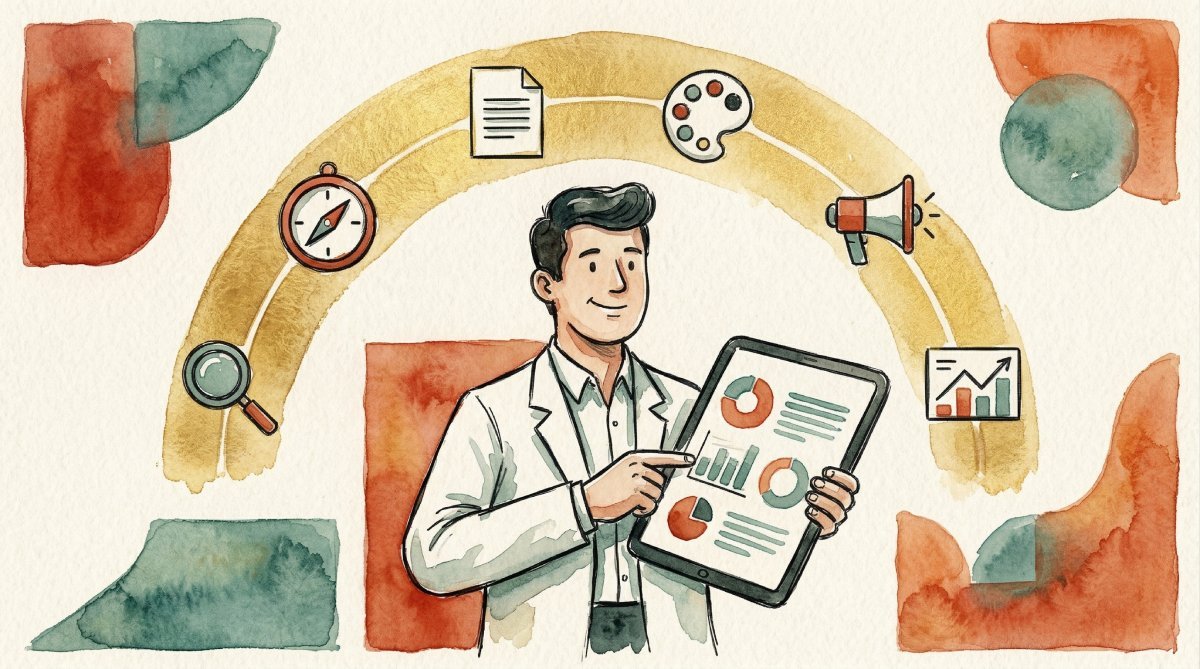
It would mean a platform that handles the full lifecycle. Six stages, not two.
- Research. Understanding your market, your competitors, and what your audience cares about right now. Not a separate research tool with its own subscription. Built into the workflow.
- Strategy. Turning research into a plan. What to create, for whom, on which channels, and why. Not a two-week planning cycle. Not a consultant. A plan that updates as conditions change.
- Content. Writing the blog post, the email, the landing page, the ad copy. Not templates you fill in. Original content built on your brand voice, your positioning, your data.
- Creative. Producing the visuals, the video, the graphics. Not stock photos with your logo on them. Assets created for your specific campaign, your specific audience.
- Distribution. Publishing across channels with orchestration. Not manual scheduling across five platforms. The right content in the right channel at the right time.
- Analysis. Measuring what worked and feeding it back into the next cycle. Not a separate analytics tool you check once a month. Continuous learning that makes every campaign smarter than the last.
That is what automating marketing means. Not "when someone downloads a PDF, send a three-email sequence." The entire program. Research through execution through analysis, connected in one system where everything learns from everything else.
Traditional marketing automation handles distribution and (partial) analysis. Two of six stages. That's not a feature gap. It's a category gap.
“Traditional marketing automation handles two of six stages. That's not a gap in features. It's a category gap.”
What This Looks Like in Practice
Abstract arguments only go so far. Here's what full-stack marketing execution looks like in real workflows.
An e-commerce brand launching a seasonal collection
The stacked way: Brief a photographer (one week). Wait for assets (two weeks). Send copy to a freelancer (three days wait). Build landing pages in one tool (two days). Set up email sequences in another (one day). Configure ads in a third (one day). Post to social manually (ongoing). Check analytics across four dashboards. Six weeks from concept to live, minimum.
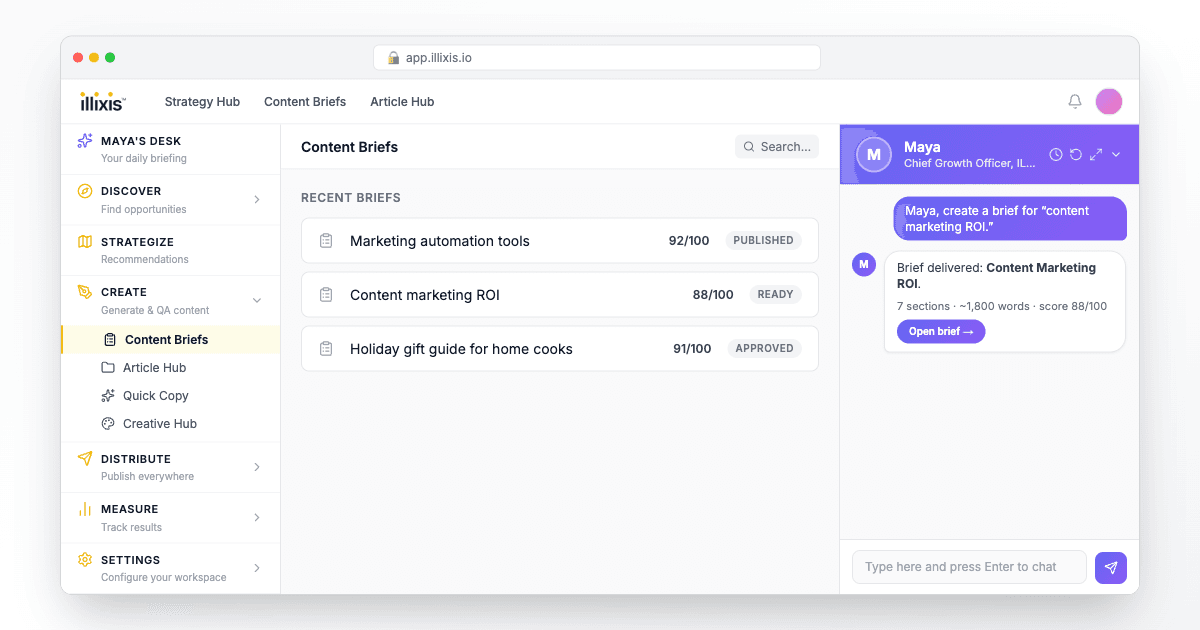
With ILLIXIS: Describe the collection and the campaign goals. The platform researches trending angles in your market, builds a content strategy, generates copy and creative assets for your review, prepares the email sequences, and queues distribution across channels. You approve. It goes live. Days, not weeks.
A B2B consultancy building a content program
The stacked way: Brainstorm topics in a meeting. Assign articles to team members who are already stretched thin. Wait for drafts. Edit. Wait again. Format for the blog. Repurpose for LinkedIn. Schedule the email. Two articles a month if you're lucky.
With ILLIXIS: The platform spots content opportunities in your market. Gaps your competitors missed, trends your audience cares about, topics that connect to your expertise. Drafts are generated in your voice. You refine the thinking, approve the direction, and the platform handles production and distribution. Consistent output without the bottleneck.
A local services company generating leads
The stacked way: Pay an agency $3,000 a month for a basic SEO and ads package. Get a monthly PDF report you barely read. Hope the phone rings. No visibility into what's working or why. Fire them after your six-month contract is up.
With ILLIXIS: Research identifies what local customers actually search for. Content targets those specific opportunities. Campaigns run across channels within your budget. You see what's working in real time, in plain language. No agency retainer. No mystery reports.
In each case, the shift is the same. You stop managing tools and start approving output. The platform handles research, strategy, creation, and distribution. You handle the decisions.
Your entire marketing program. One platform. You approve, ILLIXIS executes.
The Decision Framework
Stop building feature comparison spreadsheets. If you're evaluating how to solve your marketing execution problem, ask three questions.
- Does this solution handle the full marketing lifecycle, or just the task layer? If it only automates triggers, sequences, and scheduling, it covers 20% of your problem. You still need people or other tools for the rest. That's not a platform. That's a feature.
- Can your team go from idea to live campaign in days, not weeks? Speed to value is the single best predictor of whether an investment pays for itself. If implementation takes months or your first campaign requires weeks of setup, the tool is too complex for your team, regardless of what it can theoretically do.
- Does this reduce the number of tools, people, and hours your marketing requires? If a new tool just adds another login to the stack, it's making the problem worse. A platform that replaces three subscriptions and recovers ten hours a week is worth more than one that adds another feature to compare.
Those three questions apply whether you're a five-person startup or a 30-person department. Whether you're in e-commerce, professional services, or local business. The specific capabilities differ. The criteria don't.
Your Next Step
Audit your stack this week. Count the tools. Count the logins. Count the hours your team spends on coordination instead of marketing. Then ask one question: What would change if you could approve campaigns instead of building them?
That's what ILLIXIS does. Research, strategy, content, creative, distribution, and analysis. One platform. You approve, ILLIXIS executes. No integration tax. No tool sprawl. No coordination overhead.
Marketing, Unstacked.