Maya develops Brand Intelligence
specific to your business.
Strategic context. Live data feeds. The preferences Maya learns from every “accept” and “reject”. Composed into brand intelligence specific to your business.
The Problem
Most AI starts from zero on every query.
It writes generic marketing. And marketing is bigger than writing: research, strategy, creative, distribution, and analytics. Generic AI does not know your competitors, your tracked keywords, the trend signals worth chasing, the content gaps in your category, or the angles you have already accepted and rejected. Each prompt is a fresh introduction.
The Composition
Three sources. One Brand Intelligence.
Brand Intelligence is composed, not retrieved. Each source feeds the next.
Strategic Context
Your head term, brand keywords, competitors, voice, content exclusions, and themes. The strategic guardrails Maya operates within. Maintained by you in brand settings, never inferred.
Live Data Feeds
Tracked keyword sets, competitor moves, trend signals, content gaps, and Google Search Console data. Updated continuously. Counted at view time, no stale snapshots.
Decision Memory
Every “accept” and “reject” is a signal. The preference model learns which opportunities Maya should surface and which to filter out. Trained on your decisions, not your settings.
The Integrity Claim
Your decisions are sovereign.
Brand settings tell Maya what your brand is today. Your decisions tell Maya what your brand does. We never confuse the two.
Brand settings shape what Maya surfaces.
Your head term, competitors, keywords, exclusions, and voice are guardrails. They filter and rank the candidate opportunities Maya brings to you. They are inputs to the selection layer, not features in the model.
Decisions shape what Maya prefers.
The preference model trains exclusively on what you accept and reject. Your settings never enter the model. That separation is deliberate, and it matters.
Why the separation matters.
If brand settings fed the model, accepting an opportunity outside your stated keywords would teach the model that you do not care about your brand. You do. You are updating what your brand IS. The model needs to learn what you DO, not second-guess who you ARE. Decisions stay sovereign so your brand stays yours.
The Ladder
Brand Intelligence becomes autonomy.
The more context Maya carries about your business, the more Maya can do without asking. You move up the ladder by using the platform.
Each level unlocks when Maya has seen enough decisions to predict your taste with confidence. The ladder is not a paywall. It is a checkpoint Maya has to clear before doing more on its own. L5 is Enterprise tier; you opt in surface-by-surface in Settings.
The Proof
Climbing the ladder is not theoretical.
Every accept and reject is a vote that pushes Maya further up it. The screenshot below is our own Brand Intelligence page, live in production.
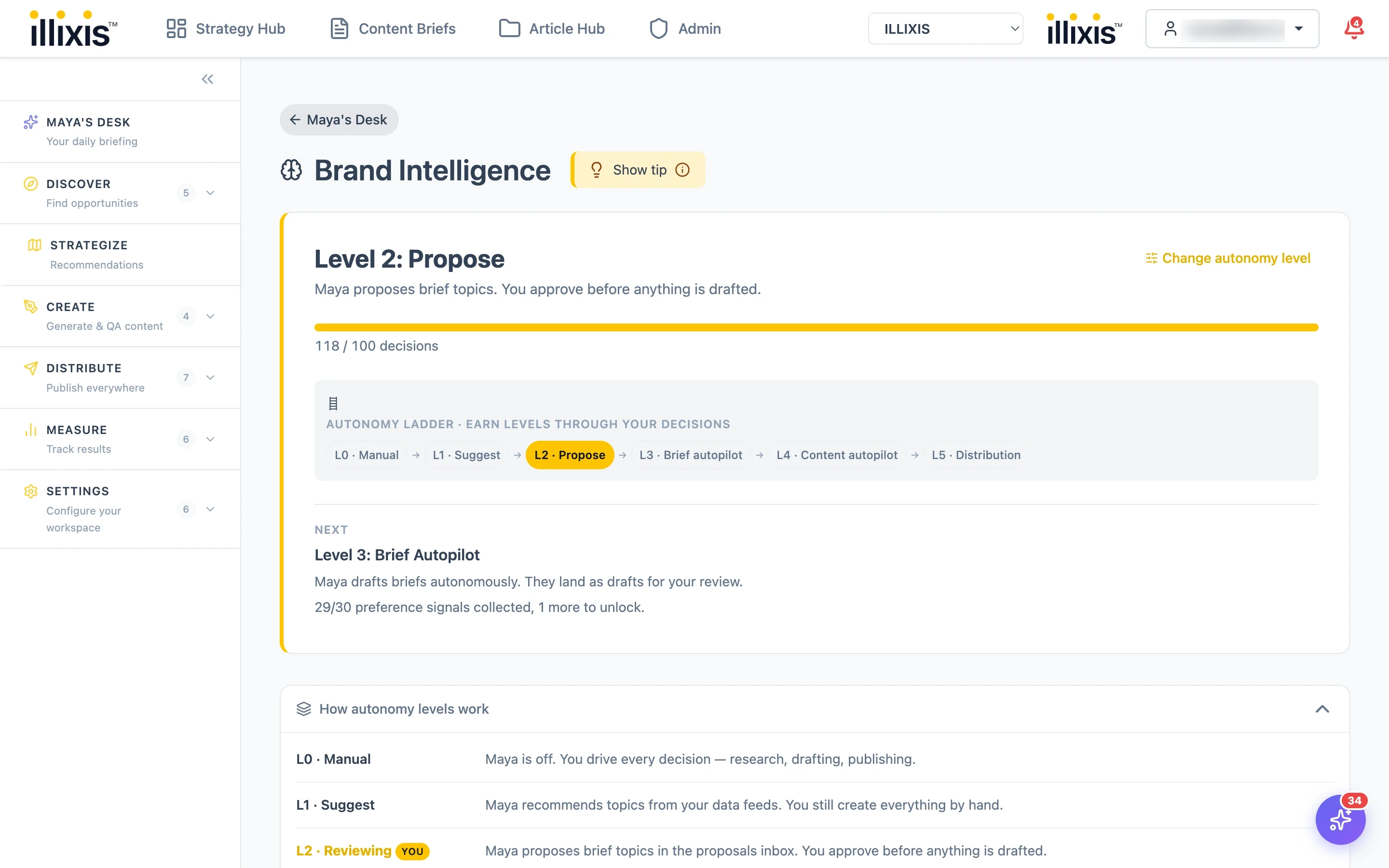
Brand Intelligence, captured from app.illixis.io/maya/intelligence/.
The Output
Every brief carries its provenance.
Maya does not just produce content. It explains, in plain language, which parts of your Brand Intelligence shaped each brief. You see exactly why an idea reached you.
Trending in your competitive set (Acme launched a comparable piece last week), built around a high-volume keyword from your tracked set, and aligned with the conversion-focused angle you have accepted in 8 of your last 10 briefs.
One sentence. Three sources of intelligence. No competitor can write that sentence about your business, because no competitor has your decisions.
The same composition shapes Maya's brand strategy, quarterly plan, and monthly plan. See how Strategic Planning works →
The Moat
The longer you use it, the further it diverges from generic AI.
On day one, Maya runs on what most marketers know. Ninety days in, Maya runs on what you know.
Strategic context. Live data feeds. No decision memory yet.
- Pulls from your brand settings.
- Watches keywords, competitors, trends, gaps.
- Surfaces opportunities the platform thinks any reasonable marketer in your category would consider.
All three sources composed. Patterns detected. Diverged from generic.
- Knows the angles you favor and the ones you skip.
- Filters categories you have rejected before they reach you.
- Surfaces opportunities your specific business would consider, not the average one.
The decisions are yours. The intelligence built from them is yours. No competitor can replicate it without a copy of every decision you have made.
Questions? Answers.
Does my Brand Intelligence train other tenants' Maya?
No. Your decisions train your preference model. Your strategic context lives on your tenant. Nothing about your business shapes another tenant's intelligence. The composition is yours alone.
Day one I have no decisions. Does Brand Intelligence work?
Yes. On day one, two of the three sources are already live: strategic context (from your brand settings) and live data feeds (keywords, competitors, trends, gaps, search console). Decision memory starts from your first “accept” or “reject”. By the time you have made thirty decisions, the preference model has enough signal to surface opportunities your way. By ninety days, the divergence from generic Maya is visible. Read more about the autonomy ladder on the Maya overview.
Can I see what Maya has learned about my preferences?
Yes. Inside the platform, the Brand Intelligence page shows your strategic context, your live data feeds, the preferences Maya has inferred from your decisions, and any rejection patterns Maya has detected. Plain language, with directional indicators showing what you favor and what you avoid. No raw weights, no statistics dump.
What if my brand changes?
Update your brand settings and the strategic guardrails update immediately. Decision memory adapts continuously. Recent decisions are weighted more heavily than old ones, so a deliberate shift in what you accept and reject reshapes the preference model on its own. No retraining ritual.
How is this different from a generic AI tool?
Generic AI tools start every query from zero. They do not know your brand. They do not know what you have accepted in the past. They do not compose multiple data sources into a single judgment. ILLIXIS does. The longer you use it, the further your Maya diverges from a generic Maya. That divergence is the moat.
Can I retrain or reset Brand Intelligence?
There is no separate training step to retrain. The model updates itself as you keep making decisions. If you want to reset, support can clear your preference history. Strategic context is always under your direct control through brand settings.
Which plans include Brand Intelligence?
Brand Intelligence is part of every ILLIXIS plan. Starter caps the autonomy ladder at L2 (Propose). Professional unlocks through L3 (Brief Autopilot). Enterprise unlocks the full L0 through L5 progression, including surface-level distribution. See pricing for the breakdown.
Day one decisions become day ninety conviction.
Start training your Brand Intelligence. The sooner you start, the further it gets ahead of any tool a competitor might pick up later.
Included with every ILLIXIS plan. Starter caps at L2. Professional unlocks through L3. Enterprise unlocks the full L0 through L5.