
Key Takeaways
- Google says AI Mode breaks one question into subtopics and runs many searches at once, so visibility depends on answering a cluster of questions, not one keyword.
- Nectiv's analysis of 60,000 fan-out queries found an average of 9.06 fan-out queries per prompt, which makes a one-keyword-per-page plan cover a small fraction of the searches.
- Prioritize sub-questions by commercial consequence and decision stage, not by keyword volume, then group them into pages and passages.
- Sub-query coverage is a metric you can compute: sub-queries your content answers divided by sub-queries in the cluster, tracked next to citation appearances.
- Fan-out coverage fails when research, writing, distribution and attribution live in separate tools that lose the cluster map between steps.
Query fan out is how Google AI Mode turns one search into many parallel sub-queries. This page explains the mechanism, shows why keyword-per-page planning leaves gaps, and gives a method to map and prioritize the question cluster. Rank questions by business consequence. Write passages that answer one each. Track coverage monthly.
What Query Fan-Out Does to a Single Search
Query fan out is a retrieval technique in which an AI search system splits one question into subtopics, runs many searches at the same time, and merges the results into one answer. Google confirms this for AI Mode. The details of the sub-queries are not published.
What Does Google Say About Fan Out?
Google launched AI Mode as an experiment in March 2025 and rolled it out in the U.S. in May 2025. Its AI Mode announcement states that it uses query fan out to break a question into subtopics and issue many queries simultaneously. Google's published documentation adds that follow-up questions keep context to refine intent.
Google's own example is a search for affordable tickets to a baseball game. Fan out can inspect hundreds of ticket options, including real-time pricing and inventory. That is confirmed. Everything below the mechanism is inference.
Think of a research desk. One manager gets a hard question, hands twelve narrower questions to twelve researchers, and merges their notes into one memo. Your page is one researcher's source. It only gets used if it answers the narrow question that researcher was given.
A Worked Example
Take this prompt: which project-management tool should our 20-person agency choose? Google has not published the sub-queries for it. The list below is an editorial illustration, not captured output.

- Definitions: what counts as project management software for agencies
- Alternatives: which tools suit teams of 10 to 30
- Pricing: per-seat cost at 20 users
- Integrations: time tracking, invoicing, chat
- Constraints: client guest access, permissions
- Reviews: what agencies report after six months
- Next steps: migration effort and trial length
One comparison page can answer maybe two of those. The rest go to other sources.
How Many Sub-Queries Are There?
Sources disagree, which is the honest answer. Nectiv's analysis reports an average of 9.06 fan-out queries per prompt. AI-Advisors puts AI Mode at 8 to 16 parallel sub-queries per request. Treat both as observations, not Google rules. Sub-queries are generated dynamically and vary between runs.
Which Surfaces Behave Differently?
AI Mode and AI Overviews are separate retrieval surfaces. An Ahrefs analysis of 730,000 response pairs found highly similar conclusions but very low citation overlap. A separate study of 540,000 query pairs, reported by Apiserpent, found only 13.7% overlap in cited URLs. Measure the two surfaces separately.
Other assistants, including Gemini, ChatGPT and Perplexity, also decompose prompts. Their depth and sources differ, and none publishes a full sub-query list. Plan for the pattern, not one engine's quirks.
Why One Keyword Per Page Stops Working
Keyword-per-page planning covers one question while the system asks many. Pages get cited for the sub-query they answer, so a page built around a head term can rank and still lose the citation. Coverage gaps mean no citation.
Citations Do Not Follow Rankings
The overlap between rankings and citations is shrinking. SearchAxe reports that as of March 2026 only 37.9% of URLs cited in AI Overviews also sat in the top 10 organic results, down from 76% in July 2025. That is a third-party figure, so read it as direction, not law.
A page can rank well for the head term and still lose the citation, because the citation goes to whoever answers the narrow sub-question.
Originality.ai found that 48% of AI Overview citations overlapped with the top 100 results, and 52% came from outside it. It does not measure AI Mode directly. It does show that conventional rankings matter and that one head-term position is an incomplete proxy.
The sharpest number comes from Fahlout: about 32.9% of cited pages got their citation from fan-out queries alone, appearing nowhere in the top 20 for the original query. Google has published no rule that pages win only on sub-queries. The pattern is observed, not confirmed.
Traffic Is Moving
The Letter Two reports that click-through rates from search to websites have fallen nearly 30% since May 2024. AEOHUB reports average drops of 34 to 61% for informational what-is-X content after AI Overviews arrived. Generic definition pages take the hit first.
There is an upside. Rand Fishkin of SparkToro put it this way: a specialist no longer has to rank for the generic query, because people express what they want more specifically. Narrow, specific pages reach buyers the head term never did.
The Cost of Thin Coverage
Thin coverage is silent. Nothing alerts you when a sub-query goes to someone else. You see flat citations and a traffic line that drifts down, and you blame the head term.
The opposite failure is real too. Publishing dozens of near-duplicate pages to chase every sub-query is topic sprawl. Google warns that generating many pages without adding user value may violate its scaled-content-abuse policy. Coverage means answering distinct questions well, not multiplying URLs.
Mapping the Question Cluster Behind Every Target Topic
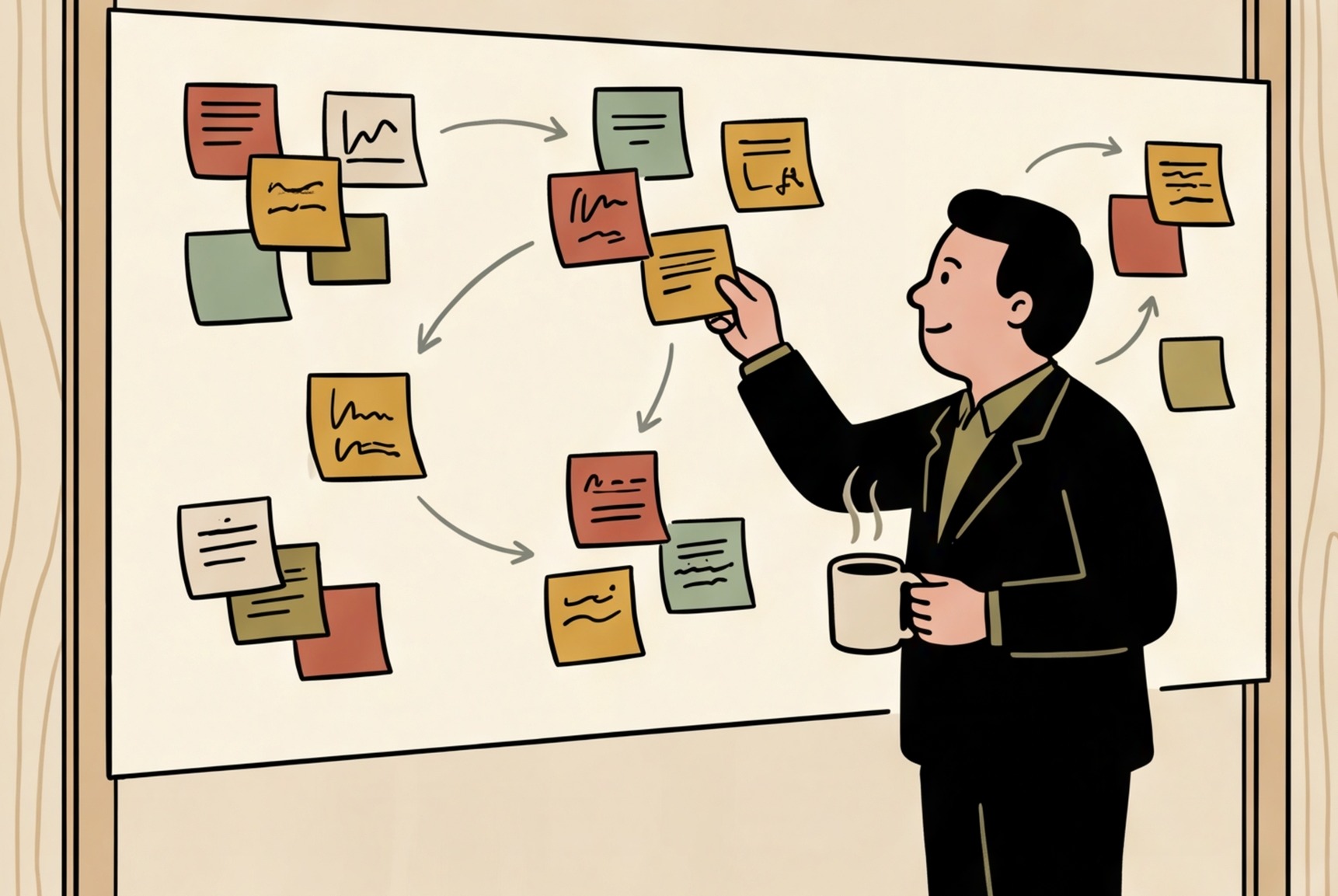
A fan-out map is a list of the sub-questions behind one topic, ranked by commercial consequence and grouped into pages. Build it in five steps. Repeat it quarterly for each topic that drives revenue.
Build the Map in Five Steps
- Pick the topic a buyer researches before purchase. One topic, not twenty.
- Run the head question in AI Mode and note the follow-ups it invites. Repeat it three times. Sub-queries vary between runs, so keep only what recurs.
- Expand by type: definitions, comparisons, constraints, pricing, objections, and next steps.
- Score each sub-question by decision stage and commercial consequence.
- Group sub-questions that share an answer into one page, and give separate intents their own page.
You cannot see Google's exact sub-queries. Semrush ran a small experiment with synthetic sub-queries and reported tracked citations rising from 2 to 5 after adding missing answers. The authors caution that the sample was tiny and volatile. It supports testing broader coverage. It proves nothing universal.
Prioritize by Consequence, Not Volume
Keyword volume ranks curiosity. Commercial consequence ranks money. A pricing-at-20-seats sub-question has tiny volume and sits one step from a purchase. A definition sub-question has large volume and sits at the top of the funnel.
Rank questions by what a lost citation costs the business, not by how many people ask them.
Score each sub-question on two axes: decision stage (learn, compare, decide) and what a lost citation costs you. Cover decide-stage questions first. Small teams have no time to cover everything, and they do not need to.
|
Sub-question type |
Decision stage |
Commercial consequence |
Priority |
|---|---|---|---|
|
Pricing at a given team size |
Decide |
High |
First |
|
Integrations and constraints |
Decide |
High |
First |
|
Alternatives and comparisons |
Compare |
Medium to high |
Second |
|
Reviews and use cases |
Compare |
Medium |
Second |
|
Definitions |
Learn |
Low |
Fold into other pages |
Group Sub-Questions Into Pages
For the agency example, the plan is four assets. One comparison page covers alternatives and use cases. One pricing page answers per-seat cost at 20 users. One integrations page covers time tracking, invoicing and permissions. One migration guide answers the next-step questions. Definitions become short sections inside those pages.
That is four pages for seven sub-questions, with every passage built to answer one thing. Fan out is dynamic, so expect to revise the map as new follow-ups appear.
Building Content That Wins the Sub-Queries in Query Fan Out Google AI Mode
A page wins a sub-query when one passage answers it directly, with evidence the other sources lack. Write each section so it stands alone as an extractable answer. No guarantee exists, but clean passages are the part you control.
Write Passages That Stand Alone
Lead every section with the answer in one or two sentences. Then give the evidence, the exception and the next step. A reader or a retrieval system that lands mid-page should get a complete answer without the sections around it.
- Put the question in the heading, in the words a buyer uses.
- State the answer first, with a number or a named entity.
- Use one term per concept across the whole cluster.
- Use tables for comparisons and lists for steps.
Add Something Others Lack
Google's helpful content guidance asks for original information, reporting, research or analysis, and content that is substantial, complete and accurate. It warns against copying or lightly rewriting other sources. A passage that restates the top ten results gives a retrieval system no reason to pick yours.

Original evidence is cheap for a small team. Publish your own pricing data, your own test results, your own customer constraints. One real number beats ten paraphrases.
Keep One Voice Across the Cluster
A cluster is several pages read together. If the pricing page says one thing and the comparison page says another, both lose trust. Fix the terms, the claims and the tone once, then apply them everywhere.
Brand voice drifts when every page starts from a blank prompt. Fact-check AI-assisted drafts by hand, as Google's guidance advises. Consistency is a process problem before it is a writing problem.
Measure Coverage You Can Compute
Use one metric: sub-queries answered divided by sub-queries in the cluster. If your map has 20 sub-questions and your content answers 8, coverage is 40%. Track it monthly next to citation appearances in AI Mode and AI Overviews, logged separately.
Watch the two lines together. Coverage up and citations flat means your passages need stronger evidence. Both rising means the map is working. Do not claim causation from one month of data.
Why a Connected Workflow Beats a Stack of Tools for Fan Out Coverage
Fan-out coverage requires the cluster map to survive from research through writing, distribution and attribution. Separate tools drop it at each handoff. A connected workflow keeps one map, one voice and one measurement trail.
Where the Map Gets Lost
Marketing teams use an average of 19 tools, and 43% report that 30 to 50% of their data is duplicated across tools, according to the Airtable Marketing Trends Report. That is a pattern we see in every stacked setup: research lives in one tool, drafts in another, the calendar in a third, analytics in a fourth.
A coverage map only works if it survives the handoffs between tools; every disconnect is where the plan quietly gets lost.
The cluster map is the first casualty. The sub-question priorities sit in a spreadsheet. The writer never sees them. The analyst reports traffic by URL, not by sub-question. Nobody can say which sub-queries are covered.
Bynder's survey found that 83% of marketing leaders want to streamline workflows and cut the number of tech solutions to fight tool fatigue. Ascend2's attribution survey of 357 marketers reports that 41% struggle to track customer touchpoints and 38% struggle with multi-channel complexity. Those are the exact breaks that stop you from tying a citation to revenue.
The Integration Tax on Coverage
Every tool boundary bleeds context. That is the integration tax, and it is paid on every campaign, not once at setup. With fan-out coverage it shows up as missing sub-questions, drifting terms and attribution that stops at the page.
The old way is five subscriptions and a dashboard shuffle to publish one cluster. Connecting them takes months, so teams spend the first quarter on integration instead of coverage.
The ILLIXIS Approach
ILLIXIS is a Full-Stack Marketing Platform. It handles research, strategy, content, creative, distribution and analytics in one system, so the cluster map is the same object at every step. ILLIXIS builds the question map, drafts publication-ready passages in your brand voice, distributes them, and ties visibility to revenue through cross-channel attribution.
You approve, ILLIXIS executes. Day one, not month three, because there is nothing to connect. ILLIXIS gets smarter every week as it learns what you approve and reject. It replaces tools, not people. Your team still decides which clusters matter.
Deloitte Digital reports that early adopters of generative AI in content marketing saved an average of 11.4 hours per week per employee. That figure describes the field as a whole. For a small team, those hours decide whether a 20-question cluster gets covered or abandoned.
Marketing, Unstacked. The stack you don't have to build. One platform.
Start with one topic. Map its sub-questions, score them by consequence, and approve the first four pages this week. Own your audience instead of renting it, and watch the coverage number climb.